MoreExam
1. Question Content...
EXPLANATION
Answer: X - EXPLANATION Content.
Question1: Your company conducts clinical trials and needs to analyze the results of a recent study that are stored in BigQuery. The interval when the medicine was taken contains start and stop dates The interval data is critical to the analysis, but specific dates may identify a particular batch and introduce bias You need to obfuscate the start and end dates for each row and preserve the interval data.What should you do?
Question2: An application running on a Compute Engine instance needs to read data from a Cloud Storage bucket. Your team does not allow Cloud Storage buckets to be globally readable and wants to ensure the principle of least privilege.Which option meets the requirement of your team?
Question3: A customer deploys an application to App Engine and needs to check for Open Web Application Security Project (OWASP) vulnerabilities.Which service should be used to accomplish this?
Question4: You are auditing all your Google Cloud resources in the production project. You want to identity all principals who can change firewall rules.What should you do?
Question5: An administrative application is running on a virtual machine (VM) in a managed group at port 5601 inside a Virtual Private Cloud (VPC) instance without access to the internet currently. You want to expose the web interface at port 5601 to users and enforce authentication and authorization Google credentials What should you do?
Question6: Which Identity-Aware Proxy role should you grant to an Identity and Access Management (IAM) user to access HTTPS resources?
Question7: A retail customer allows users to upload comments and product reviews. The customer needs to make sure the text does not include sensitive data before the comments or reviews are published.Which Google Cloud Service should be used to achieve this?
Question8: In an effort for your company messaging app to comply with FIPS 140-2, a decision was made to use GCP compute and network services. The messaging app architecture includes a Managed Instance Group (MIG) that controls a cluster of Compute Engine instances. The instances use Local SSDs for data caching and UDP for instance-to-instance communications. The app development team is willing to make any changes necessary to comply with the standard Which options should you recommend to meet the requirements?
Question9: Your company's chief information security officer (CISO) is requiring business data to be stored in specific locations due to regulatory requirements that affect the company's global expansion plans. After working on a plan to implement this requirement, you determine the following:* The services in scope are included in the Google Cloud data residency requirements.* The business data remains within specific locations under the same organization.* The folder structure can contain multiple data residency locations.* The projects are aligned to specific locations.You plan to use the Resource Location Restriction organization policy constraint with very granular control.At which level in the hierarchy should you set the constraint?
Question10: A customer's data science group wants to use Google Cloud Platform (GCP) for their analytics workloads.Company policy dictates that all data must be company-owned and all user authentications must go through their own Security Assertion Markup Language (SAML) 2.0 Identity Provider (IdP). The Infrastructure Operations Systems Engineer was trying to set up Cloud Identity for the customer and realized that their domain was already being used by G Suite.How should you best advise the Systems Engineer to proceed with the least disruption?
Question11: Your organization uses Google Workspace Enterprise Edition tor authentication. You are concerned about employees leaving their laptops unattended for extended periods of time after authenticating into Google Cloud. You must prevent malicious people from using an employee's unattended laptop to modify their environment.What should you do?
Question12: Your team needs to prevent users from creating projects in the organization. Only the DevOps team should be allowed to create projects on behalf of the requester.Which two tasks should your team perform to handle this request? (Choose two.)
Question13: You want to prevent users from accidentally deleting a Shared VPC host project. Which organization-level policy constraint should you enable?
Question14: A customer's internal security team must manage its own encryption keys for encrypting data on Cloud Storage and decides to use customer-supplied encryption keys (CSEK).How should the team complete this task?
Question15: You are a member of the security team at an organization. Your team has a single GCP project with credit card payment processing systems alongside web applications anddata processing systems. You want to reduce the scope of systems subject to PCI audit standards.What should you do?
Question16: Your organization acquired a new workload. The Web and Application (App) servers will be running on Compute Engine in a newly created custom VPC. You are responsible for configuring a secure network communication solution that meets the following requirements:Only allows communication between the Web and App tiers.Enforces consistent network security when autoscaling the Web and App tiers.Prevents Compute Engine Instance Admins from altering network traffic.What should you do?
Question17: Your organization wants to be compliant with the General Data Protection Regulation (GDPR) on Google Cloud You must implement data residency and operational sovereignty in the EU.What should you do?Choose 2 answers
Question18: You need to provide a corporate user account in Google Cloud for each of your developers and operational staff who need direct access to GCP resources. Corporate policy requires you to maintain the user identity in a third-party identity management provider and leverage single sign-on. You learn that a significant number of users are using their corporate domain email addresses for personal Google accounts, and you need to follow Google recommended practices to convert existing unmanaged users to managed accounts.Which two actions should you take? (Choose two.)
Question19: Your team needs to obtain a unified log view of all development cloud projects in your SIEM. The development projects are under the NONPROD organization folder with the test and pre-production projects.The development projects share the ABC-BILLING billing account with the rest of the organization.Which logging export strategy should you use to meet the requirements?
Question20: Your security team uses encryption keys to ensure confidentiality of user data. You want to establish a process to reduce the impact of a potentially compromised symmetric encryption key in Cloud Key Management Service (Cloud KMS).Which steps should your team take before an incident occurs? (Choose two.)
Question21: Your privacy team uses crypto-shredding (deleting encryption keys) as a strategy to delete personally identifiable information (PII). You need to implement this practice on Google Cloud while still utilizing the majority of the platform's services and minimizing operational overhead. What should you do?
Question22: A customer's company has multiple business units. Each business unit operates independently, and each has their own engineering group. Your team wants visibility into all projects created within the company and wants to organize their Google Cloud Platform (GCP) projects based on different business units. Each business unit also requires separate sets of IAM permissions.Which strategy should you use to meet these needs?
Question23: Your team needs to make sure that a Compute Engine instance does not have access to the internet or to any Google APIs or services.Which two settings must remain disabled to meet these requirements? (Choose two.)
Question24: Your application is deployed as a highly available cross-region solution behind a global external HTTP(S) load balancer. You notice significant spikes in traffic from multiple IP addresses but it is unknown whether the IPs are malicious. You are concerned about your application's availability. You want to limit traffic from these clients over a specified time interval.What should you do?
Question25: You are backing up application logs to a shared Cloud Storage bucket that is accessible to both the administrator and analysts. Analysts should not have access to logs that contain any personally identifiable information (PII). Log files containing PII should be stored in another bucket that is only accessible to the administrator. What should you do?
Question26: A website design company recently migrated all customer sites to App Engine. Some sites are still in progress and should only be visible to customers and company employees from any location.Which solution will restrict access to the in-progress sites?
Question27: A customer needs to launch a 3-tier internal web application on Google Cloud Platform (GCP). The customer's internal compliance requirements dictate that end-user access may only be allowed if the traffic seems to originate from a specific known good CIDR. The customer accepts the risk that their application will only have SYN flood DDoS protection. They want to use GCP's native SYN flood protection.Which product should be used to meet these requirements?
Question28: A company is backing up application logs to a Cloud Storage bucket shared with both analysts and the administrator. Analysts should only have access to logs that do not contain any personally identifiable information (PII). Log files containing PII should be stored in another bucket that is only accessible by the administrator.What should you do?
Question29: An engineering team is launching a web application that will be public on the internet. The web application is hosted in multiple GCP regions and will be directed to the respective backend based on the URL request.Your team wants to avoid exposing the application directly on the internet and wants to deny traffic from a specific list of malicious IP addresses Which solution should your team implement to meet these requirements?
Question30: A patch for a vulnerability has been released, and a DevOps team needs to update their running containers in Google Kubernetes Engine (GKE).How should the DevOps team accomplish this?
Question31: Your organization must comply with the regulation to keep instance logging data within Europe. Your workloads will be hosted in the Netherlands in region europe-west4 in a new project. You must configure Cloud Logging to keep your data in the country.What should you do?
Question32: You are tasked with exporting and auditing security logs for login activity events for Google Cloud console and API calls that modify configurations to Google Cloud resources. Your export must meet the following requirements:Export related logs for all projects in the Google Cloud organization.Export logs in near real-time to an external SIEM.What should you do? (Choose two.)
Question33: Your DevOps team uses Packer to build Compute Engine images by using this process:1 Create an ephemeral Compute Engine VM.2 Copy a binary from a Cloud Storage bucket to the VM's file system.3 Update the VM's package manager.4 Install external packages from the internet onto the VM.Your security team just enabled the organizational policy. consrraints/compure.vnExtemallpAccess. to restrict the usage of public IP Addresses on VMs. In response your DevOps team updated their scripts to remove public IP addresses on the Compute Engine VMs however the build pipeline is failing due to connectivity issues.What should you do?Choose 2 answers
Question34: Applications often require access to "secrets" - small pieces of sensitive data at build or run time. The administrator managing these secrets on GCP wants to keep a track of "who did what, where, and when?" within their GCP projects.Which two log streams would provide the information that the administrator is looking for? (Choose two.)
Question35: Your Google Cloud organization allows for administrative capabilities to be distributed to each team through provision of a Google Cloud project with Owner role (roles/ owner). The organization contains thousands of Google Cloud Projects Security Command Center Premium has surfaced multiplecpen_myscl_portfindings.You are enforcing the guardrails and need to prevent these types of common misconfigurations.What should you do?
Question36: Your company wants to determine what products they can build to help customers improve their credit scores depending on their age range. To achieve this, you need tojoin user information in the company's banking app with customers' credit score data received from a third party. While using this raw data will allow you to complete this task, it exposes sensitive data, which could be propagated into new systems.This risk needs to be addressed using de-identification and tokenization with Cloud Data Loss Prevention while maintaining the referential integrity across the database. Which cryptographic token format should you use to meet these requirements?
Question37: Your company recently published a security policy to minimize the usage of service account keys.On-premises Windows-based applications are interacting with Google Cloud APIs. You need to implement Workload Identity Federation (WIF) with your identity provider on-premises.What should you do?
Question38: You manage your organization's Security Operations Center (SOC). You currently monitor and detect network traffic anomalies in your VPCs based on network logs. However, you want to explore your environment using network payloads and headers. Which Google Cloud product should you use?
Question39: You need to enable VPC Service Controls and allow changes to perimeters in existing environments without preventing access to resources. Which VPC Service Controls mode should you use?
Question40: You manage one of your organization's Google Cloud projects (Project A). AVPC Service Control (SC) perimeter is blocking API access requests to this project including Pub/Sub. A resource running under a service account in another project (Project B) needs to collect messages from a Pub/Sub topic in your project Project B is not included in a VPC SC perimeter. You need to provide access from Project B to the Pub/Sub topic in Project A using the principle of least Privilege.What should you do?
Question41: A company is running workloads in a dedicated server room. They must only be accessed from within the private company network. You need to connect to these workloads from Compute Engine instances within a Google Cloud Platform project.Which two approaches can you take to meet the requirements? (Choose two.)
Question42: Your team sets up a Shared VPC Network where project co-vpc-prod is the host project. Your team has configured the firewall rules, subnets, and VPN gateway on the host project. They need to enable Engineering Group A to attach a Compute Engine instance to only the 10.1.1.0/24 subnet.What should your team grant to Engineering Group A to meet this requirement?
Question43: In order to meet PCI DSS requirements, a customer wants to ensure that all outbound traffic is authorized.Which two cloud offerings meet this requirement without additional compensating controls? (Choose two.)
Question44: Your organization is moving virtual machines (VMs) to Google Cloud. You must ensure that operating system images that are used across your projects are trusted and meet your security requirements.What should you do?
Question45: A customer wants to make it convenient for their mobile workforce to access a CRM web interface that is hosted on Google Cloud Platform (GCP). The CRM can only be accessed by someone on the corporate network. The customer wants to make it available over the internet. Your team requires an authentication layer in front of the application that supports two-factor authentication Which GCP product should the customer implement to meet these requirements?
Question46: Last week, a company deployed a new App Engine application that writes logs to BigQuery. No other workloads are running in the project. You need to validate that all data written to BigQuery was done using the App Engine Default Service Account.What should you do?
Question47: Your company runs a website that will store PII on Google Cloud Platform. To comply with data privacy regulations, this data can only be stored for a specific amount of time and must be fully deleted after this specific period. Data that has not yet reached the time period should not be deleted. You want to automate the process of complying with this regulation.What should you do?
Question48: You need to implement an encryption at-rest strategy that reduces key management complexity for non-sensitive data and protects sensitive data while providing the flexibility of controlling the key residency and rotation schedule. FIPS 140-2 L1 compliance is required for all data types. What should you do?
Question49: You work for a large organization where each business unit has thousands of users. You need to delegate management of access control permissions to each business unit. You have the following requirements:Each business unit manages access controls for their own projects.Each business unit manages access control permissions at scale.Business units cannot access other business units' projects.Users lose their access if they move to a different business unit or leave the company.Users and access control permissions are managed by the on-premises directory service.What should you do? (Choose two.)
Question50: You are part of a security team that wants to ensure that a Cloud Storage bucket in Project A can only be readable from Project B. You also want to ensure that data in the Cloud Storage bucket cannot be accessed from or copied to Cloud Storage buckets outside the network, even if the user has the correct credentials.What should you do?
Question51: You are the project owner for a regulated workload that runs in a project you own and manage as an Identity and Access Management (IAM) admin. For an upcoming audit, you need to provide access reviews evidence.Which tool should you use?
Question52: Your organization s customers must scan and upload the contract and their driver license into a web portal in Cloud Storage. You must remove all personally identifiable information (Pll) from files that are older than 12 months. Also you must archive the anonymized files for retention purposes.What should you do?
Question53: A customer wants to run a batch processing system on VMs and store the output files in a Cloud Storage bucket. The networking and security teams have decided that no VMs may reach the public internet.How should this be accomplished?
Question54: You need to use Cloud External Key Manager to create an encryption key to encrypt specific BigQuery data at rest in Google Cloud. Which steps should you do first?
Question55: You want data on Compute Engine disks to be encrypted at rest with keys managed by Cloud Key Management Service (KMS). Cloud Identity and Access Management (IAM) permissions to these keys must be managed in a grouped way because the permissions should be the same for all keys.What should you do?
Question56: You have numerous private virtual machines on Google Cloud. You occasionally need to manage the servers through Secure Socket Shell (SSH) from a remote location. You want to configure remote access to the servers in a manner that optimizes security and cost efficiency.What should you do?
Question57: A DevOps team will create a new container to run on Google Kubernetes Engine. As the application will be internet-facing, they want to minimize the attack surface of the container.What should they do?
Question58: A company has been running their application on Compute Engine. A bug in the application allowed a malicious user to repeatedly execute a script that results in the Compute Engine instance crashing. Although the bug has been fixed, you want to get notified in case this hack re-occurs.What should you do?
Question59: An organization's security and risk management teams are concerned about where their responsibility lies for certain production workloads they are running in Google Cloud Platform (GCP), and where Google's responsibility lies. They are mostly running workloads using Google Cloud's Platform-as-a-Service (PaaS) offerings, including App Engine primarily.Which one of these areas in the technology stack would they need to focus on as their primary responsibility when using App Engine?
Question60: You work for an organization in a regulated industry that has strict data protection requirements. The organization backs up their data in the cloud. To comply with data privacy regulations, this data can only be stored for a specific length of time and must be deleted after this specific period.You want to automate the compliance with this regulation while minimizing storage costs. What should you do?
Question61: An office manager at your small startup company is responsible for matching payments to invoices and creating billing alerts. For compliance reasons, the office manager is only permitted to have the Identity and Access Management (IAM) permissions necessary for these tasks. Which two IAM roles should the office manager have? (Choose two.)
Question62: Which two implied firewall rules are defined on a VPC network? (Choose two.)
Question63: You need to implement an encryption-at-rest strategy that protects sensitive data and reduces key management complexity for non-sensitive data. Your solution has the following requirements:* Schedule key rotation for sensitive data.* Control which region the encryption keys for sensitive data are stored in.* Minimize the latency to access encryption keys for both sensitive and non-sensitive data.What should you do?
Question64: Your organization hosts a financial services application running on Compute Engine instances for a third-party company. The third-party company's servers that will consume the application also run on Compute Engine in a separate Google Cloud organization. You need to configure a secure network connection between the Compute Engine instances. You have the following requirements:The network connection must be encrypted.The communication between servers must be over private IP addresses.What should you do?
Question65: You are a Security Administrator at your organization. You need to restrict service account creation capability within production environments. You want to accomplish this centrally across the organization. What should you do?
Question66: You are working with protected health information (PHI) for an electronic health record system. The privacy officer is concerned that sensitive data is stored in the analytics system. You are tasked with anonymizing the sensitive data in a way that is not reversible. Also, the anonymized data should not preserve the character set and length. Which Google Cloud solution should you use?
Question67: While migrating your organization's infrastructure to GCP, a large number of users will need to access GCP Console. The Identity Management team already has a well-established way to manage your users and want to keep using your existing Active Directory or LDAP server along with the existing SSO password.What should you do?
Question68: Your Security team believes that a former employee of your company gained unauthorized access to Google Cloud resources some time in the past 2 months by using a service account key. You need to confirm the unauthorized access and determine the user activity. What should you do?
Question69: Your organization previously stored files in Cloud Storage by using Google Managed Encryption Keys (GMEK). but has recently updated the internal policy to require Customer Managed Encryption Keys (CMEK). You need to re-encrypt the files quickly and efficiently with minimal cost.What should you do?
Question70: You are troubleshooting access denied errors between Compute Engine instances connected to a Shared VPC and BigQuery datasets. The datasets reside in a project protected by a VPC Service Controls perimeter. What should you do?
Question71: You need to audit the network segmentation for your Google Cloud footprint. You currently operate Production and Non-Production infrastructure-as-a-service (IaaS) environments. All your VM instances are deployed without any service account customization.After observing the traffic in your custom network, you notice that all instances can communicate freely - despite tag-based VPC firewall rules in place to segment traffic properly - with a priority of 1000. What are the most likely reasons for this behavior?
Question72: Your organization wants to be General Data Protection Regulation (GDPR) compliant You want to ensure that your DevOps teams can only create Google Cloud resources in the Europe regions.What should you do?
Question73: Employees at your company use their personal computers to access your organization s Google Cloud console.You need to ensure that users can only access the Google Cloud console from their corporate-issued devices and verify that they have a valid enterprise certificate What should you do?
Question74: You are the security admin of your company. You have 3,000 objects in your Cloud Storage bucket. You do not want to manage access to each object individually. You also do not want the uploader of an object to always have full control of the object. However, you want to use Cloud Audit Logs to manage access to your bucket.What should you do?
Question75: Your company is using GSuite and has developed an application meant for internal usage on Google App Engine. You need to make sure that an external user cannot gain access to the application even when an employee's password has been compromised.What should you do?
Question76: You are a member of your company's security team. You have been asked to reduce your Linux bastion host external attack surface by removing all public IP addresses. Site Reliability Engineers (SREs) require access to the bastion host from public locations so they can access the internal VPC while off-site. How should you enable this access?
Question77: Your organization wants full control of the keys used to encrypt data at rest in their Google Cloud environments. Keys must be generated and stored outside of Google and integrate with many Google Services including BigQuery.What should you do?
Question78: Your organization recently activated the Security Command Center {SCO standard tier. There are a few Cloud Storage buckets that were accidentally made accessible to the public. You need to investigate the impact of the incident and remediate it.What should you do?
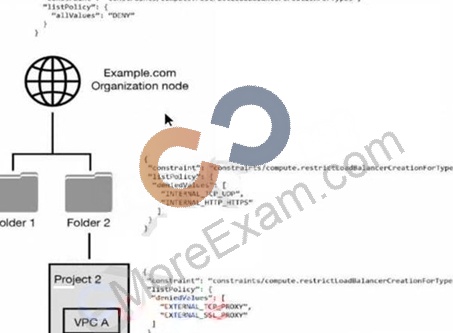
Question79: You have the following resource hierarchy. There is an organization policy at each node in the hierarchy as shown. Which load balancer types are denied in VPC A?
Question80: You have a highly sensitive BigQuery workload that contains personally identifiable information (Pll) that you want to ensure is not accessible from the internet. To prevent data exfiltration only requests from authorized IP addresses are allowed to query your BigQuery tables.What should you do?
Question81: An organization adopts Google Cloud Platform (GCP) for application hosting services and needs guidance on setting up password requirements for their Cloud Identity account. The organization has a password policy requirement that corporate employee passwords must have a minimum number of characters.Which Cloud Identity password guidelines can the organization use to inform their new requirements?
Question82: You run applications on Cloud Run. You already enabled container analysis for vulnerability scanning.However, you are concerned about the lack of control on the applications that are deployed. You must ensure that only trusted container images are deployed on Cloud Run.What should you do?Choose 2 answers
Question83: A business unit at a multinational corporation signs up for GCP and starts moving workloads into GCP. The business unit creates a Cloud Identity domain with an organizational resource that has hundreds of projects.Your team becomes aware of this and wants to take over managing permissions and auditing the domain resources.Which type of access should your team grant to meet this requirement?
Question84: Users are reporting an outage on your public-facing application that is hosted on Compute Engine. You suspect that a recent change to your firewall rules is responsible. You need to test whether your firewall rules are working properly. What should you do?
Question85: You are setting up a CI/CD pipeline to deploy containerized applications to your production clusters on Google Kubernetes Engine (GKE). You need to prevent containers with known vulnerabilities from being deployed. You have the following requirements for your solution:Must be cloud-nativeMust be cost-efficientMinimize operational overheadHow should you accomplish this? (Choose two.)
Question86: Your company's users access data in a BigQuery table. You want to ensure they can only access the data during working hours.What should you do?
Question87: You want to use the gcloud command-line tool to authenticate using a third-party single sign-on (SSO) SAML identity provider. Which options are necessary to ensure that authentication is supported by the third-party identity provider (IdP)? (Choose two.)
Question88: Your company operates an application instance group that is currently deployed behind a Google Cloud load balancer in us-central-1 and is configured to use the Standard Tier network. The infrastructure team wants to expand to a second Google Cloud region, us-east-2. You need to set up a single external IP address to distribute new requests to the instance groups in both regions.What should you do?
Question89: Your organization has had a few recent DDoS attacks. You need to authenticate responses to domain name lookups. Which Google Cloud service should you use?
Question90: In a shared security responsibility model for IaaS, which two layers of the stack does the customer share responsibility for? (Choose two.)
Question91: A large e-retailer is moving to Google Cloud Platform with its ecommerce website. The company wants to ensure payment information is encrypted between the customer's browser and GCP when the customers checkout online.What should they do?
Question92: You control network traffic for a folder in your Google Cloud environment. Your folder includes multiple projects and Virtual Private Cloud (VPC) networks You want to enforce on the folder level that egress connections are limited only to IP range 10.58.5.0/24 and only from the VPC network dev-vpc." You want to minimize implementation and maintenance effort What should you do?
Question93: You manage your organization's Security Operations Center (SOC). You currently monitor and detect network traffic anomalies in your Google Cloud VPCs based on packet header information. However, you want the capability to explore network flows and their payload to aid investigations. Which Google Cloud product should you use?
Question94: Your company requires the security and network engineering teams to identify all network anomalies within and across VPCs, internal traffic from VMs to VMs, traffic between end locations on the internet and VMs, and traffic between VMs to Google Cloud services in production. Which method should you use?
Question95: You are in charge of migrating a legacy application from your company datacenters to GCP before the current maintenance contract expires. You do not know what ports the application is using and no documentation is available for you to check. You want to complete the migration without putting your environment at risk.What should you do?